How High the Moon
An armchair with the full bulk of an upholstered club chair, built from nothing but steel mesh you can see straight through.
How High the Moon, shown in the collection galleries of the Musée national d'art moderne, Paris.
PHOTOGRAPH Sailko / commons.wikimedia.org / CC BY 3.0
Plates 2
Overview
An armchair by Shiro Kuramata, designed in 1986. Back, arms and seat are reduced to simple cubic forms in expanded steel mesh, soldered together and nickel-plated. There is no separate frame and no upholstery. The mesh is the structure, the surface and the outline at once.
The Röhsska Museum credits manufacture to Terada Tekkojo Ltd. Bijutsu Techo says Vitra made and sold it outside Japan from 1986 to 2009. The Met's example measures 71.8 × 95.3 × 81 cm, which is the size of a heavy lounge chair, yet the Vitra Design Museum describes the result as surprisingly lightweight.
What to notice
- The outline is the structureThere is no frame inside the mesh. Each panel holds the next one up, so the line you read as the chair's silhouette is also what carries your weight.
- Moiré at every edgeWhere two layers of mesh overlap, at the arms against the back, the diamond pattern interferes with itself. The shimmer moves as you walk round the chair.
- Even the feet are meshThe four short legs are small cylinders of the same mesh. From a distance the chair seems to sit on nothing, which the Nelson-Atkins catalogue also notes.
- A club chair in outlineCurved back, squared arms, deep seat. The proportions belong to an upholstered armchair. Kuramata kept the shape and took away everything that usually fills it.
Historical context
Kuramata (1934–1991) worked with unusual industrial materials such as acrylic and rib mesh, and the Vitra Design Museum describes his objects as sitting between function and suggestion. His Glass Chair of 1976, made of glass sheets bonded with adhesive, is the same impulse in a different material. The Vitra Design Museum's text calls How High the Moon a weighty symbol of bourgeois life translated into postmodern industrial terms.
Vitra gave examples to museums early. The Met's chair was a gift of Vitra in 1988, and the V&A's came from Vitra Ltd., London. The V&A's catalogue reads the design as a polemical or ironic statement more than a comfortable chair. The Vitra Design Museum says the opposite: the generous proportions and the give of the mesh make it comfortable to sit in.
Connections
Formal resemblance
- Nitush-Aroosh, Nitush + Aroosh
Nitush-Aroosh hydroform steel until it looks inflated. Kuramata goes the other way and makes steel look like air. Both use metal against its expected weight.
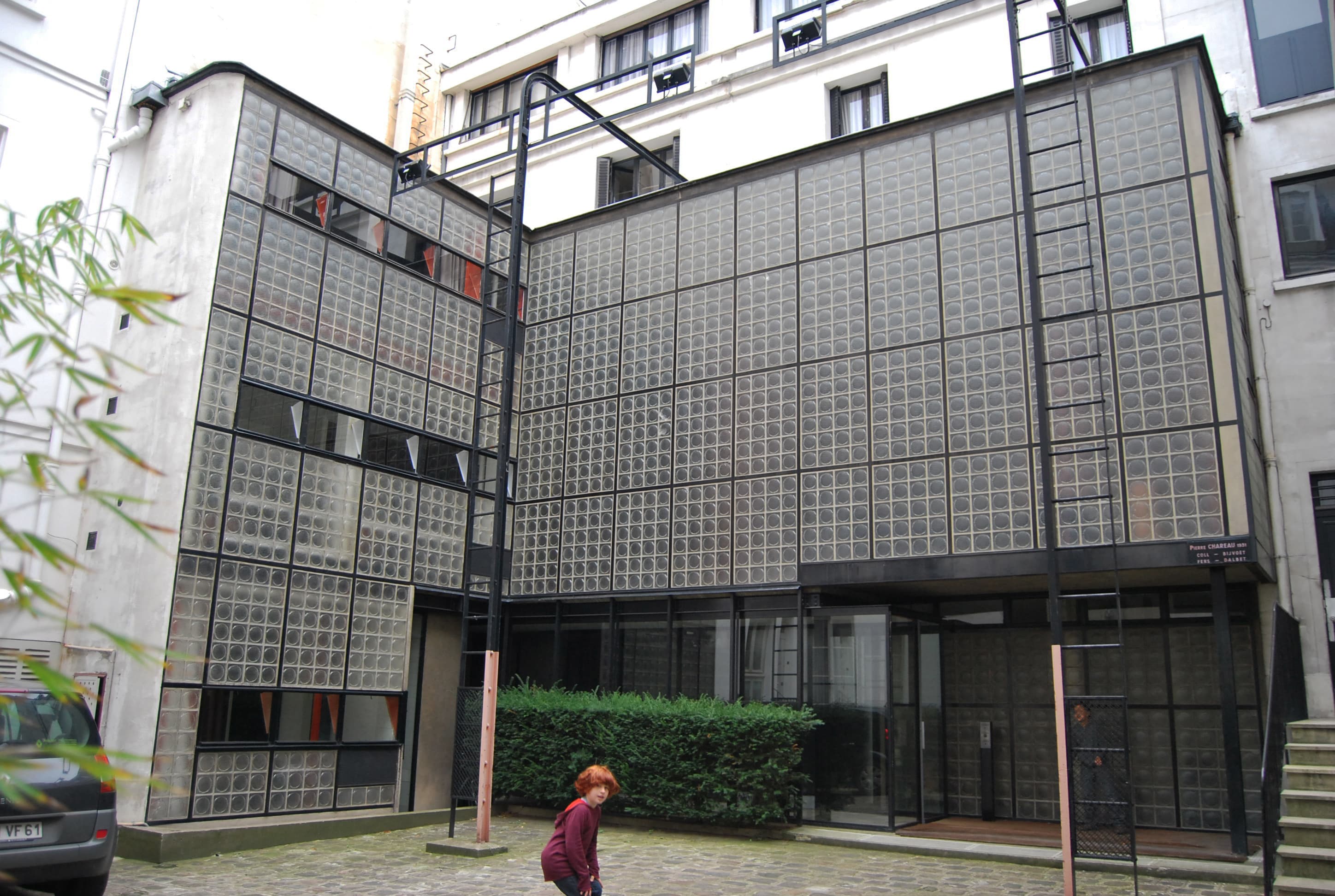
- Maison de Verre, Pierre Chareau + Bernard Bijvoet
Both take a material made for industry, glass block there and expanded metal mesh here, and use it for the most domestic thing in the room. In both, light passes through what should be solid.
- Quaderna Series, Superstudio / Zanotta
Both are pieces of furniture that read as statements about furniture. Superstudio's grid denies the object was made; Kuramata's mesh denies it has weight. The V&A frames this chair as polemical rather than comfortable.
Sources and further exploration
- collection.design-museum.de
- How High the Moon (GJP-1001-1)
Design 1986, production 1993; 73.0 × 95.0 × 82.0 cm.
- "How High the Moon" Armchair (1988.186)
- Armchair, How High the Moon (W.6-1990)
- How high the moon (RKM 23-2006)
Credits manufacture to Terada Tekkojo Ltd.
- Kuramata's How High the Moon reissued
Japanese. Sales history and the 2019 reissue.