Bunker Archeology
The reasoning behind Sainte-Bernadette: Virilio's long study of the abandoned Atlantic Wall bunkers as a new kind of architecture.
Bunker Archéologie, Spector Books edition, 2025. Cover.
PHOTOGRAPH Cover: Spector Books / spectorbooks.comReferenced from its source. Rights not established by SIMULACRA.
Plates 2
Overview
A book of essays and photographs by Paul Virilio about the German bunkers of the Atlantic Wall, the coastal defences built along the French coast during the Second World War. He began photographing them in the second half of the 1950s, when they stood abandoned in the dunes.
In plain terms, the book treats the bunkers as buildings worth reading closely. Virilio reads their mass and form, and what they say about military space and communications warfare. He called them harbingers of a new architecture.
What to notice
- Half photographsThe book is a visual essay as much as a text. Look at how often the bunker is shot alone against sand or sea, with no figure for scale.
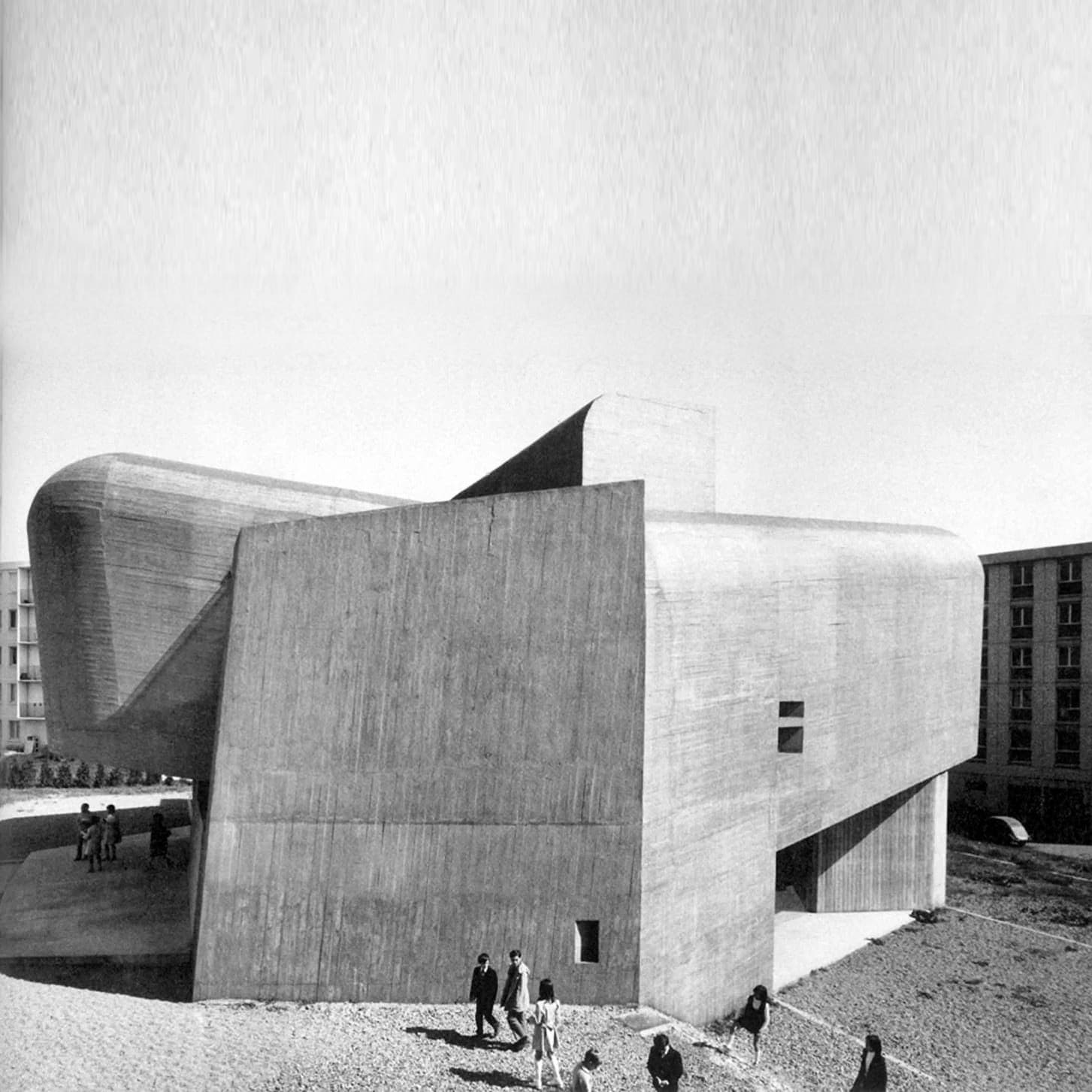
- Tilted by the groundThe blockhaus in the Quend-Plage photograph has sunk into the dune at an angle, so its walls no longer stand true. Compare that with the deliberate slopes inside Sainte-Bernadette.
- Rounded, not squareThe bunker on the 2025 cover has a thick rounded edge and a narrow slot. The mass is shaped to deflect, which is why it reads as sculpture.
- Which edition you haveThe 1975 French catalogue, the 1994 English translation and the 2025 trilingual Spector edition are three different books in design and length. The English edition runs to 214 pages.
Historical context
Virilio first showed the photographs in 1966 in Architecture Principe, the magazine he co-edited with the architect Claude Parent. The same year Parent and Virilio completed the church of Sainte-Bernadette du Banlay in Nevers. The book followed in 1975, published for an exhibition organised by the Centre de création industrielle at the Musée des arts décoratifs in Paris, while the Centre Pompidou was still being set up.
The English translation by George Collins appeared from Princeton Architectural Press in 1994. A new trilingual edition from Spector Books came out in 2025 alongside a Centre Pompidou exhibition. A common misreading, offered here as interpretation: the book is often taken as photography of ruins with a theory attached. Spector's notes place it the other way round, as the first statement of themes Virilio kept for the rest of his work, from military space to speed.
Connections
Shared context
- Sainte-Bernadette du Banlay, Claude Parent + Paul Virilio
Virilio co-designed the church with Claude Parent as Architecture Principe and first published his bunker photographs in their magazine in 1966, the year the church was built. Whether the bunkers shaped the church directly is not stated in the sources read here.
- Simulacra and Simulation, Jean Baudrillard
Virilio co-founded the review Cause commune in 1972 with Jean Baudrillard and Georges Perec. The two entries share a circle of Paris writers in the 1970s, not a single argument.
Formal resemblance
- City by Michael Heizer, Michael Heizer
Concrete forms set alone in sand and open ground, read as monuments to a power that has left. A visual likeness only; no source connects them.
Sources and further exploration
- spectorbooks.com
- Paul Virilio: Bunker Archéologie
2025 edition in French, English and German. 212 pages, 102 black and white illustrations.
- Bunker archeology (Princeton Architectural Press, 1994)
Catalogue record for the English translation by George Collins.
- Bunker archéologie (Centre Georges Pompidou, CCI, 1975)
Catalogue record for the French first edition, with the exhibition dates.
- Bunker Archaeology (1994)
Short summary of the book.