Body without Organs
Gilles Deleuze + Félix Guattari · 1980
OVERVIEW
A concept from Deleuze and Guattari's A Thousand Plateaus, published in French in 1980 and translated by Brian Massumi in 1987. The phrase is borrowed from Antonin Artaud.
The argument, stripped of its vocabulary: a body is not the same thing as its organisation. What we call a body is a set of functions assigned to parts, arranged in a fixed hierarchy, and that arrangement is historical rather than natural. The body without organs is not a body missing its organs; it is a body considered before or apart from the organisation imposed on it, a field of possible arrangements rather than one settled one.
WHY IT MATTERS
A usable way of thinking about bodies, garments and buildings as things that are organised rather than things that are simply given.
CONTEXT
It sits in a long chapter of a difficult book and is routinely quoted out of it. The authors are explicit that this is not a metaphor for liberation and not an instruction to destroy anything; they warn repeatedly that emptying out the organisation too fast produces a corpse rather than a possibility.
Its usefulness here is practical, not decorative. Kawakubo displacing the silhouette, Parent tilting the floor so standing becomes a decision, Cronenberg staging surgery as performance and Nakagin assigning a life to a module are all the same move: taking an arrangement that presents itself as natural and showing that it was assigned.
WHAT TO NOTICE
- 01It is not anti-bodyThe concept is about organisation, not anatomy. Reading it as a fantasy of dissolving the body is the most common error and the authors pre-empt it.
- 02Artaud's phraseThe term comes from a 1947 radio play. Knowing that keeps it closer to theatre and the voice than to biology.
- 03The warning in the middleThey insist you cannot do this recklessly. The chapter's most quoted lines are its most cautious ones, which is usually lost.
- 04Where it is usefulApply it where a form is presented as natural and turns out to be assigned: a silhouette, a floor plane, a dwelling unit, a working day.
CONNECTIONS
- THE ARRANGEMENT IS ASSIGNEDBody Meets Dress, Dress Meets Body / Rei Kawakubo / Comme des Garçons
Kawakubo's padding displaces the anatomy the garment trade treats as given. That is Deleuze and Guattari's point in cloth: what looks like a natural body turns out to be a settled organisation.
- STANDING BECOMES A DECISIONSainte-Bernadette du Banlay / Claude Parent + Paul Virilio
Parent and Virilio tilt the floor until posture stops being automatic. The oblique function is the concept built: an arrangement of the body that had passed for natural, made visible by removing it.
- ORGANS AS ARRANGEMENTCrimes of the Future / David Cronenberg
Cronenberg's premise is a body that grows new organs and a state that registers them. The film is the concept taken literally, including the bureaucracy, which is the part philosophy usually leaves out.
EXPLORE FURTHER
- BOOK / University of Minnesota PressA Thousand Plateaus
The Massumi translation, which is the standard English edition and where the concept actually lives.
RELATED SIGNALS
RELATED ENTRIES
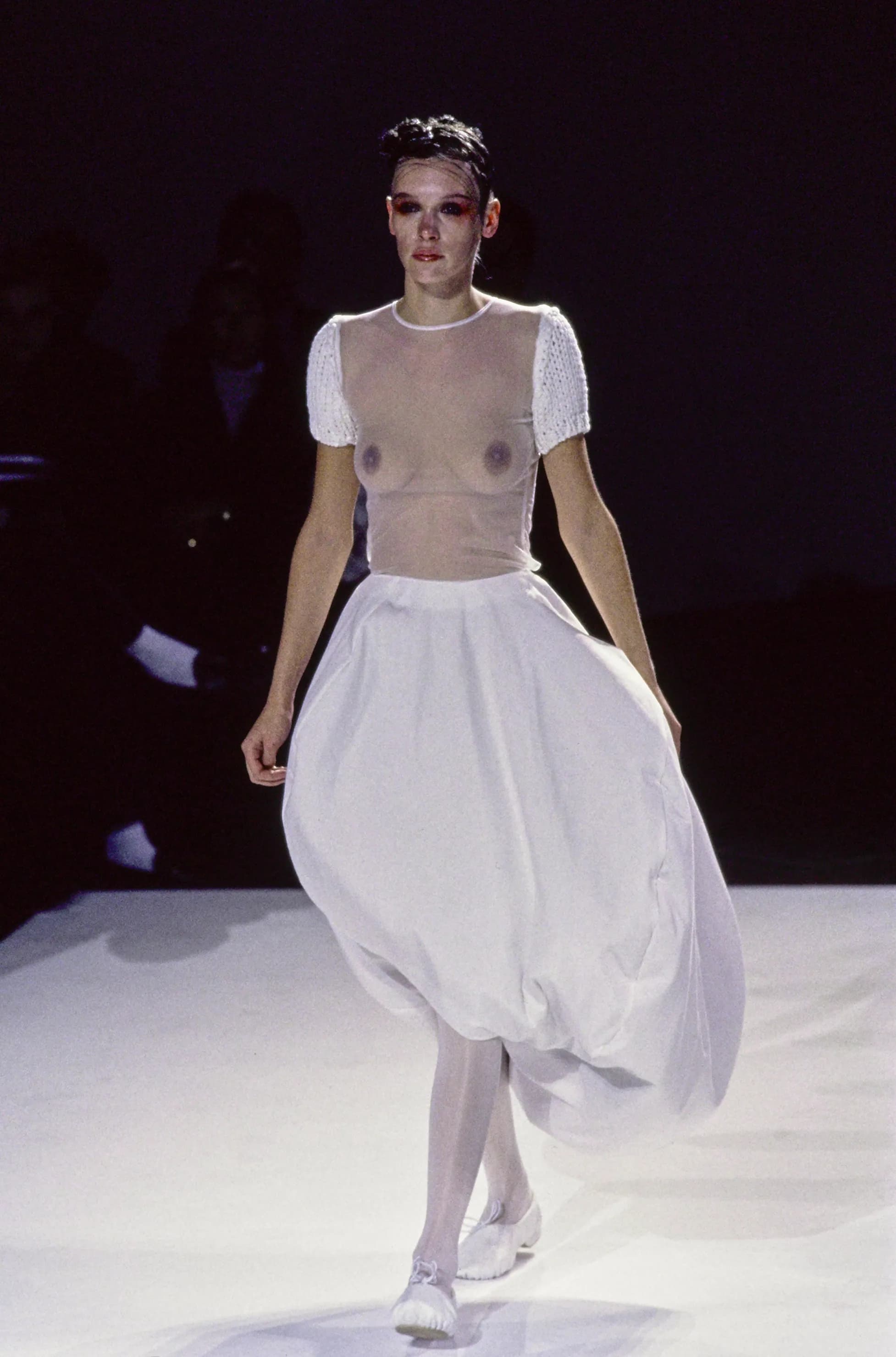
SB-FAS-005
Body Meets Dress, Dress Meets Body
Rei Kawakubo / Comme des Garçons · Spring/Summer 1997
SB-PER-002
Severe Futurism — wardrobe formula
SIMULACRA.BLACK · 2026
SB-FIL-004
The Substance
Coralie Fargeat · 2024
SB-TXT-001
Learning from Las Vegas
Robert Venturi, Denise Scott Brown, Steven Izenour · 1972
SB-TXT-002
Simulacra and Simulation
Jean Baudrillard · 1981
SB-FIL-002
Crimes of the Future
David Cronenberg · 2022

SB-SND-003
HEALTH
HEALTH · 2005–
SB-ART-003
Torqued Ellipses
Richard Serra · 1996–1999