Carol Christian Poell
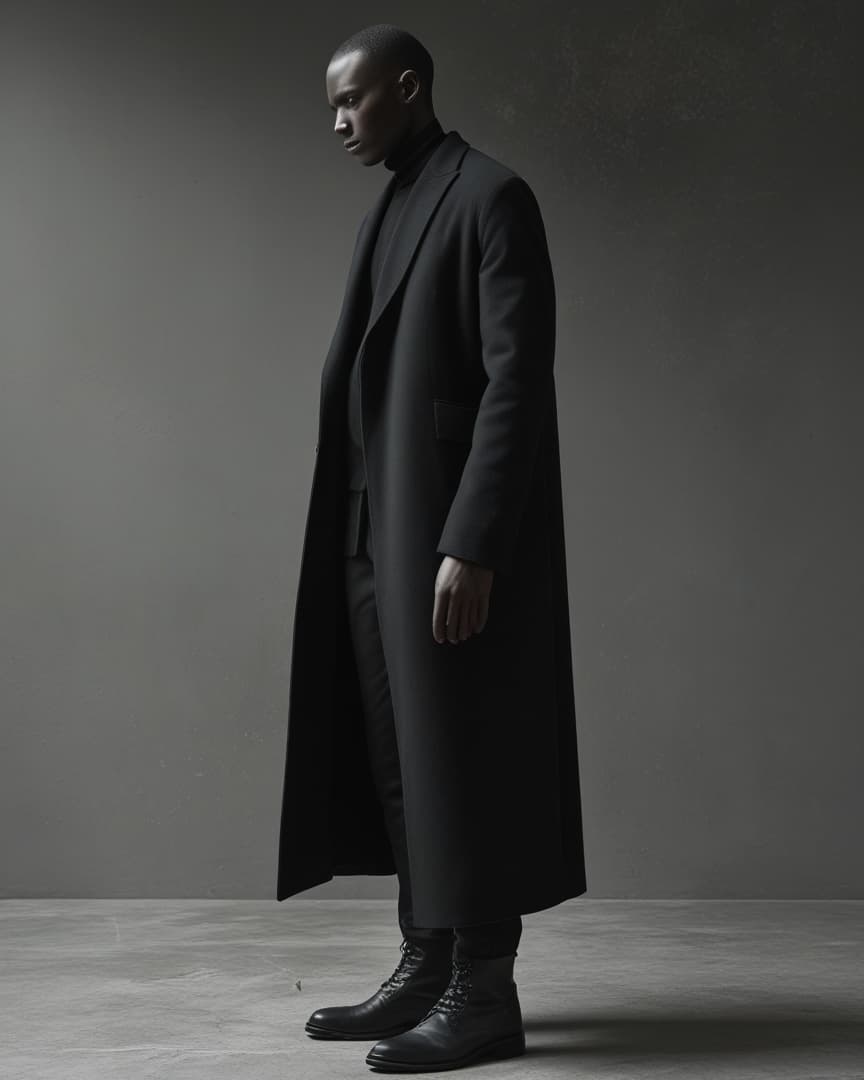
Menswear built and then treated as a finished object, dyed or rubbered after assembly, so seams and leather record the process unevenly.
Sleeveless jacket worn over a sleeved waistcoat, c. 2010. Wool with silk lining. V&A, given by Charlie Porter (T.115:1&2-2015).
PHOTOGRAPH © Victoria and Albert Museum, London / collections.vam.ac.ukReferenced from its source. Rights not established by SIMULACRA.
Plates 3
Overview
Carol Christian Poell is an Austrian designer, born in 1966 to a family with a long background in tanning and leather, who took a postgraduate design course at Domus Academy in Milan. He founded his label there in 1994 with Sergio Simone. The Westminster Menswear Archive credits his family's tannery background for his experimental methods of cutting and assembling clothes.
Two treatments recur in the current work, both applied after a garment or shoe is assembled. Object dyeing dyes the finished piece whole, which The Library, his London stockist, says produces surface variation unique to each piece. Drip rubber applies liquid polyurethane to the completed construction so it runs and sets on the surface, which the stockist calls a melting aesthetic. The footwear adds whole-cut leather uppers with no seams and exposed titanium prosthetic ankle inserts.
Selected works
What to notice
- Looks together, isn'tOn the V&A piece the jacket stops at the shoulder and the sleeves come from the waistcoat underneath. Charlie Porter, who owned it, said it 'looks together but also not quite right'.
- The legs swing backThe Autumn/Winter 1997 trousers are cut so the legs fall backward when laid flat. On the body that leaves extra cloth gathered at the knee.
- Process left on the surfaceDrip rubber runs where gravity takes it, so on the gloves it pools and points at the fingertips. No two pairs can set the same way.
- Seams as informationThe 2003 cord jacket is unlined and every inside seam is covered in a 1 cm black tape glued on. The construction is meant to be seen from the inside.
Historical context
Poell is known as much for where he shows as for what he shows. The Westminster Menswear Archive lists a slaughterhouse, a morgue and Milan's Naviglio Grande canal among his venues, and an Autumn/Winter 2001 video presentation, Public Freedom, with models locked in the cages of a municipal dog pound.
The canal show was Mainstream Downstream, for Spring/Summer 2004, staged in June 2003. i-D describes models carried down the Naviglio Grande on inflatable floats with arms outstretched, wearing red-soaked leathers with white tailoring and garment edges joined by threads like medical stitching. As i-D quotes him, Poell said “This collection and this presentation are my take on the state of fashion now.”
Connections
Shared context
- JULIUS — industrial tailoring, Tatsuro Horikawa / JULIUS
The JULIUS entry already places the label in the same conversation as Poell. Both are menswear labels where the interest sits in construction rather than print or logo.
- Rick Owens — architectural silhouette, Rick Owens
The archive treats Owens as its foundational wardrobe reference, and Poell works in the same leather-heavy avant-garde menswear. Owens works through silhouette; Poell works through what happens to material after it is sewn.
Formal resemblance
- Crimes of the Future, David Cronenberg
Medical-looking stitches, prosthetic boot inserts and treated skin put Poell's work in the same visual territory as Cronenberg's surgical body. This is a resemblance, not a documented link.
Personal association
- Severe Futurism — wardrobe formula, SIMULACRA.BLACK
The wardrobe formula lists Poell among the designers it draws on. This entry is the reference that name points to.
Sources and further exploration
- uwestminster.test.accesstomemory.net
- Carol Christian Poell Trousers (2018.109)
Includes the archive's label history.
- Jacket and waistcoat (T.115:1&2-2015)
- Inside the Show Fashion Could Never Forget
Eilidh Duffy, 3 October 2024, on Mainstream Downstream.
- Object Dyed Drip Rubbered Leather Gloves
Stockist; describes both treatments.