Red Desert
Antonioni's first colour film looks at a petrochemical landscape as both beautiful and poisoned, and makes colour carry what the characters cannot say.
Red Desert (1964). Steam venting at the plant.
PHOTOGRAPH Still: Red Desert (1964), as published by the Criterion Collection / criterion.comReferenced from its source. Rights not established by SIMULACRA.
Plates 3
Overview
Michelangelo Antonioni's 1964 film, made after L'avventura, La notte and L'eclisse, and his first in colour. Monica Vitti plays Giuliana, the wife of an industrial manager, whose hold on herself is slipping among the refineries and power plants outside Ravenna. Richard Harris plays Corrado, her husband's colleague, who pays her the attention her husband does not.
The camera stays on pylons, pipework, docked ships and abandoned fishing huts with a painter's patience. Red, the colour in the title, is held back until late.
Credits
What to notice
- The opening noiseThe film starts with a misty strike scene outside the plant, and the soundtrack pounds for its first ten minutes. Le Fanu reads that sound as the film's own comment on the new landscape.
- The painted fruitPublicity said Antonioni had fruit on a street cart painted. Watch the cart and ask whether you would have noticed without being told. Le Fanu thinks most viewers would not.
- A blue stripeIn a meeting about sending workers to Argentina, Corrado drifts off and follows a painted blue stripe along the wall with his eyes. A line of colour does the acting.
- The red room in the hutAt the quayside hut the friends end up piled together in a small inner room painted red, while the conversation is about aphrodisiacs. Le Fanu notes that the film otherwise holds red back from emphasis until the climax, so the room stands out.
- The island storyGiuliana tells her son a story about a girl on a desert island. It is filmed in clear blues, yellows and whites, a different palette from everything around it.
Historical context
The setting is real. The petrochemical companies SAROM and ANIC, both named in the film, began refining around Ravenna in the 1950s during Italy's economic boom, and their plants are the background of the opening scenes. The film won the Golden Lion at Venice.
Carlo Di Palma shot it, Piero Poletto was art director and Giovanni Fusco wrote the music. Publicity at the time made much of Antonioni having Poletto paint parts of the living landscape and some objects, such as fruit on a street cart. Mark Le Fanu, writing for Criterion, finds that the finished film owes less to those interventions than the publicity suggested.
Connections
Formal resemblance
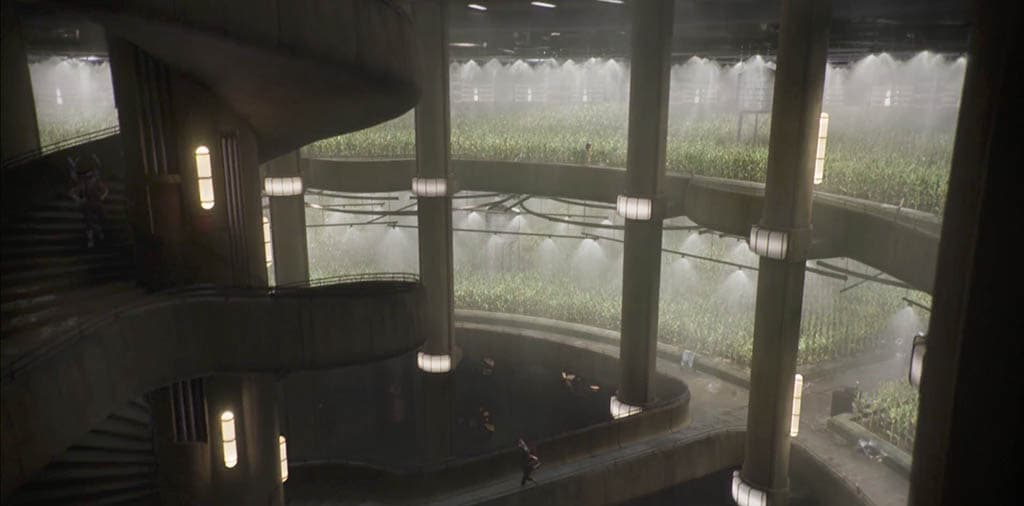
- Silo, Graham Yost
Pipes, plant and machinery are the setting and the mood in both, not background. Resemblance only; no source links them.
- Severance, Dan Erickson
Severance uses green as almost the only saturated colour on the floor; Red Desert uses painted stripes and walls the same way. A likeness of method, not a documented influence.
- Einstürzende Neubauten, Einstürzende Neubauten
The film opens on factory sound pushed to the front, which is the territory Neubauten later made into music. Resemblance only.
Sources and further exploration
- criterion.com
- Red Desert: In This World
Mark Le Fanu, 21 June 2010.
- Red Desert
Spine 522.