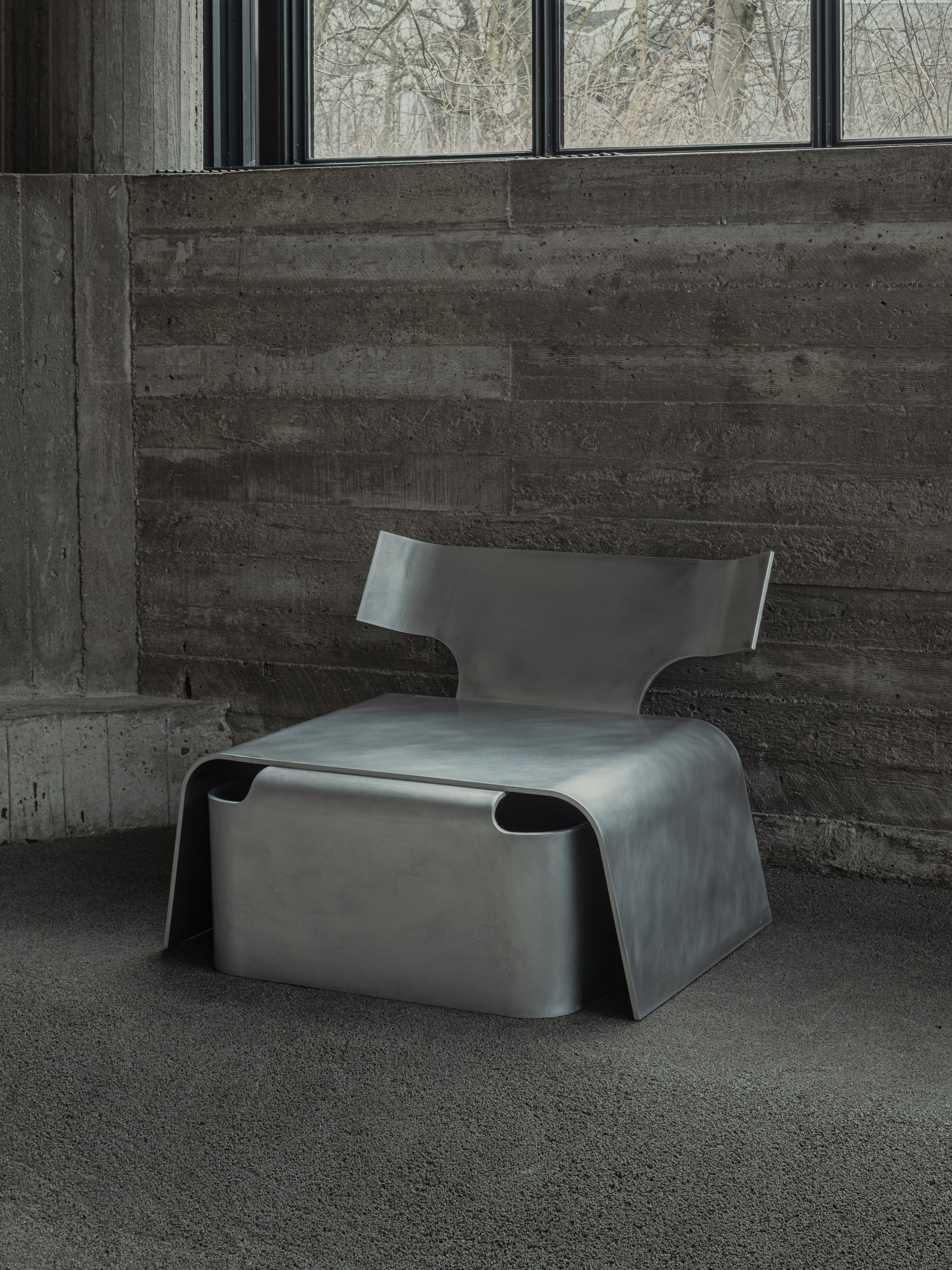
Photograph by Lindefreya0610. Source: Wikimedia Commons. Licensed CC BY-SA 4.0. The stored file is the unmodified 3750×5000 original; responsive presentation may crop the image for layout.
PHOTOGRAPH Lindefreya0610 / Wikimedia Commons / CC BY-SA 4.0
Destroyers/Builders
Linde Freya Tangelder · contemporary
OVERVIEW
The practice of Linde Freya Tangelder, founded in 2014 and working between Antwerp and Brussels. The objects are furniture, but the vocabulary is architectural: columns, lintels, plinths and reveals reduced to the size of a chair.
Materials are mixed high and low deliberately, cast aluminium against lacquered timber, waxed stone against brass, with the hand's marks left in the finish rather than sanded out.
WHY IT MATTERS
Contemporary collectible design that turns brushed metal and primitive mass into quiet, highly refined furniture.
CONTEXT
Tangelder trained at Design Academy Eindhoven. The studio describes its subject as an interaction between furniture and architectural elements, materials or building techniques, which is an unusually precise statement of intent for the field.
The work circulates through galleries and collaborations rather than catalogue production: a chair shown with Kassl Editions at Paris Photo, the Wax Stone Light made for Cassina in Milan in 2023.
WHAT TO NOTICE
- 01Furniture at building scaleLook for the architectural element being quoted: a column base, a lintel, a stepped plinth. The pieces are small buildings before they are seats.
- 02The hand is left visibleFinishes are worked rather than machined. Tool marks and unevenness are part of the surface and are not corrected.
- 03Two materials, one jointMost pieces set one heavy material against one refined one and show exactly where they meet.
- 04Lit from one sideIn the studio's own photography the objects are raked by a single light. The facets are the subject, so the shadow is doing the describing.
CONNECTIONS
- ARCHITECTURE AT FURNITURE SCALEMonolith Studio / Marc Personick / Monolith
Two contemporary studios treating a chair as a small building. Monolith stacks volcanic stone and lets gravity be the joint; Tangelder quotes columns and lintels and shows exactly where two materials meet.
EXPLORE FURTHER
- OFFICIAL / destroyersbuilders.comDestroyers/Builders
Objects, projects and open editions, with the studio's own statement on the info page.
RELATED SIGNALS
RELATED ENTRIES
SB-ART-002
Jordan Wolfson — recent sculpture
Jordan Wolfson · 2026
SB-OBJ-008
Goslo Studio
Alejandro Gómez Slok · contemporary
SB-INT-002
101 Spring Street
Donald Judd · 1968–
SB-FIL-003
Infinity Pool
Brandon Cronenberg · 2023
SB-ARC-002
Sainte-Bernadette du Banlay
Claude Parent + Paul Virilio · 1963–1966
SB-ART-001
Untitled concrete works
Donald Judd · various
SB-FAS-003
Yohji Yamamoto — black volume
Yohji Yamamoto · ongoing
SB-OBJ-002
Monolith Studio
Marc Personick / Monolith · 2023–